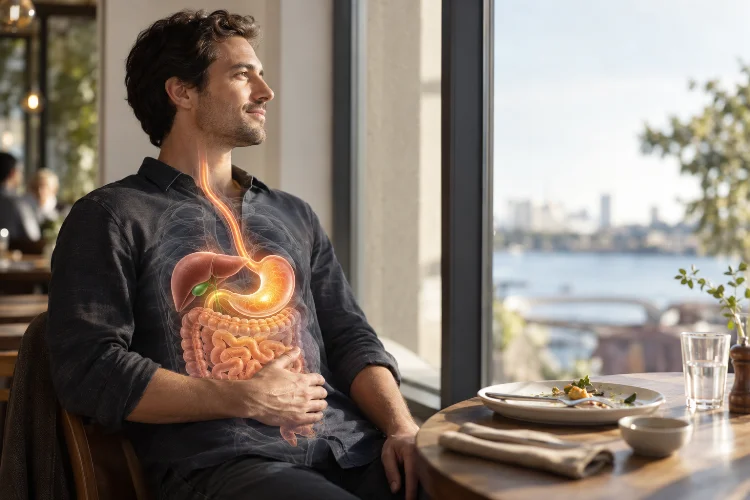
You finish lunch, put down your fork, and move on with your day. But inside your body, the meal has only just started an impressive journey.
So, what happens to food after you eat it? Food does not simply fall into your stomach and somehow turn into energy.
It travels through a coordinated digestive system involving your mouth, esophagus, stomach, intestines, liver, pancreas, gallbladder, blood vessels, nerves, hormones, and even trillions of microorganisms living in your gut.
During this process, large pieces of food are gradually broken into smaller molecules. Carbohydrates can become simple sugars, proteins are separated into amino acids, and fats are broken into fatty acids and other components that your body can absorb and use.
Some of those nutrients become fuel. Others help build tissues, support hormones, maintain cells, or are stored for later.
Let’s follow your food from the first bite all the way to its final destination.
Digestion Actually Starts in Your Mouth
Many people think digestion begins in the stomach, but the process starts the moment food enters your mouth.
Your teeth perform mechanical digestion by cutting, crushing, and grinding food into smaller pieces. This creates more surface area for digestive enzymes to work on later.
At the same time, your salivary glands release saliva. Besides making food easier to swallow, saliva contains enzymes that begin breaking down starches, a type of carbohydrate.
Imagine eating a piece of bread. While your teeth physically break the bread apart, enzymes in your saliva are already beginning the chemical side of digeston.
Your tongue then helps form the chewed food into a soft mass called a bolus and pushes it toward the back of your throat.
Once you swallow, much of the next stage happens automatically.
The Esophagus Moves Food Toward Your Stomach
After swallowing, food enters the esophagus, a muscular tube connecting your throat to your stomach.
Food does not simply fall downward because of gravity. Instead, waves of muscular contractions called peristalsis push it through the digestive tract.
This is one reason you can technically swallow even when your body is not completely upright.
As food approaches the stomach, it passes through a ring-like muscle known as the lower esophageal sphincter. This muscle opens to let food enter and normally closes afterward, helping prevent stomach contents from moving backward into the esophagus.
At this point, your meal may still resemble food, but that changes dramatically once it reaches the stomach.
Your Stomach Mixes Food With Acid and Enzymes
The stomach works like a muscular mixing chamber.
Its walls contract and churn food while glands release stomach acid and digestive enzymes. These substances help break food down further, particularly proteins.
Stomach acid also creates an acidic environment that supports digestive processes. Meanwhile, the muscular movement of the stomach mixes everything together.
Eventually, your recognizable meal becomes a thick, semi-liquid mixture called chyme.
The stomach does not usually release an entire meal into the small intestine at once. Instead, it gradually empties chyme into the first section of the small intestine.
How quickly this happens can vary depending on several factors, including meal size and composition. Foods containing different amounts of fat, protein, carbohydrate, fiber, and liquid may move through the stomach at different rates.
So when you feel full for several hours after a large meal, there is still plenty of digestive procesing happening behind the scenes.
The Small Intestine Does Most of the Nutrient Absorption
Despite its name, the small intestine plays an enormous role in digestion.
Once chyme enters it, digestive fluids from several organs join the process. The pancreas produces enzymes that help break down carbohydrates, fats, and proteins. The liver produces bile, while the gallbladder stores and releases bile to help with fat digestion.
The small intestine also produces digestive juices of its own.
Together, these substances continue breaking food into molecules that are small enough to cross the intestinal wall.
Carbohydrates, Proteins, and Fats Take Different Paths
Carbohydrates are generally broken down into simple sugars such as glucose. Proteins become amino acids, while dietary fats are broken into fatty acids and related molecules.
These nutritents are then absorbed through the wall of the small intestine.
Most absorbed nutrients enter the bloodstream and are transported to other parts of the body. The liver plays an important role in processing, storing, and distributing many of them. Some fats are absorbed through the lymphatic system before eventually entering circulation.
This absorpsion stage is one of the main reasons digestion matters. Eating nutritious food is useful only if the body can break it down and absorb what it needs.
What Does Your Body Do With the Nutrients?
Once nutrients enter your bloodstream, their journey becomes even more interesting.
Glucose from carbohydrates can be used by cells to produce energy. Your body may also store some glucose in the form of glycogen, particularly in the liver and muscles, for later use.
Amino acids from protein can help build and repair tissues and contribute to the production of many important compounds within the body.
Dietary fats can provide energy, become part of cell structures, and help support the absorption of fat-soluble vitamins.
In other words, that sandwich you ate does not remain a sandwich for very long. Its individual components may eventually contribute to energy production, muscle repair, cell maintenance, or stored fuel.
The NIDDK explains that digestion allows the body to use nutrients for energy, growth, and cell repair.
Your body is constantly deciding whether nutrients should be used immediately, transformed, transported, or stored.
The Large Intestine Handles Water, Bacteria, and Waste
Not everything you eat gets absorbed in the small intestine.
The remaining material eventually moves into the large intestine, also known as the colon. This includes water, undigested food components, fiber, and waste products.
One major job of the large intestine is absorbing additional water. As water is removed, the remaining material gradually becomes more solid and forms stool.
But the colon is not simply a waste-storage tube.
It also contains a huge community of microorganisms commonly referred to as the gut microbiome. These bacteria and other microbes interact with material that reaches the colon and can help break down certain substances that your own digestive enzymes cannot fully process.
NIDDK notes that bacteria in the large intestine help break down remaining nutrients and can produce vitamin K.
Dietary fiber is particularly interesting because much of it is not digested in the same way as sugars, proteins, or fats. Certain types can instead become fuel for gut microbes.
That is one reason fiber-rich foods such as vegetables, fruits, legumes, and whole grains play an important role in digestive health.
How Does Food Finally Leave the Body?
After the colon has absorbed water and processed the remaining material, waste moves toward the rectum.
The rectum acts as temporary storage for stool. When enough stool accumulates, nerves send signals that create the familiar urge to have a bowel movement.
Muscles then coordinate to allow stool to pass through the anus.
This is the final stage of the digestive journey, but it does not mean every part of your meal simply became waste.
By this point, much of what your body could use has already been absorbed. Water has been recovered, nutrients have entered circulation, and undigested material has been processed by intestinal bacteria.
The material that leaves the body mainly consists of water, bacteria, undigested food components, substances released into the digestive tract, and cells shed from the intestinal lining.
Your Brain, Hormones, and Gut Help Control the Whole Process
Digestion may look like a simple tube from mouth to anus, but the system is highly coordinated.
Nerves and hormones help control when digestive juices are released, how quickly food moves through different organs, and even signals related to hunger and fullness.
The digestive tract also contains its own extensive network of nerves known as the enteric nervous system.
These nerves help coordinate intestinal muscle contractions and other digestive functions. Meanwhile, communication continues between the gastrointestinal tract and the central nervous system.
You may notice this connection when stress affects your stomach, when the smell of food makes your mouth water, or when seeing a favorite meal suddenly makes you feel hungry.
Digestion, therefore, is not performed by one organ. It is the result of many systems working together every time you eat.
So, what happens to food after you eat it? Your meal begins a carefully coordinated journey through the digestive tract.
Chewing and saliva start breaking it down, the stomach mixes it with acid and enzymes, and the small intestine completes much of the digestion while absorbing nutrients.
Those nutrients then travel through your bloodstream or lymphatic system, where they can support energy production, growth, tissue repair, and other essential functions.
What remains moves into the large intestine, where water is absorbed, gut bacteria process certain materials, and waste eventually becomes stool.
The next time you sit down for a meal, remember that your body is doing far more than simply filling your stomach.
CTA: Support that process by eating a varied diet, staying adequately hydrated, including fiber-rich foods, and paying attention to how your digestive system responds to your everyday meals.