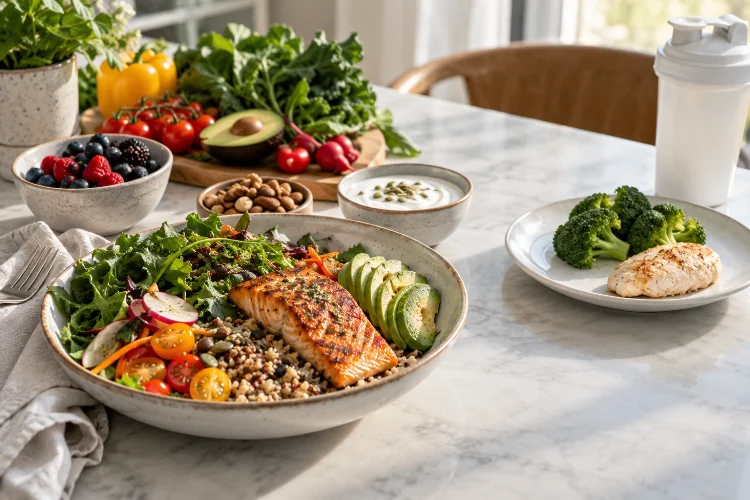
People often use the words diet and nutrition as if they mean exactly the same thing. Someone might say they are “improving their nutrition” because they started a new diet, while another person may assume that being on a diet automatically means eating healthy food.
The two ideas are closely connected, but they are not identical.
Understanding the Difference Between Diet and Nutrition can help you make better decisions about food without getting trapped by confusing health trends or restrictive eating plans.
Your diet describes what you regularly eat and drink, while nutrition is more concerned with the nutrients your body receives and how it uses them.
That distinction matters because a person can follow a particular dietary pattern without necessarily getting good nutrition. On the other hand, healthy nutrition does not require following a trendy or highly restrictive diet.
Once you understand how these concepts work together, building healthier eating habits becomes much more practical.
What Does “Diet” Actually Mean?
The word diet often makes people think about weight loss. You may picture calorie restrictions, avoiding carbohydrates, skipping desserts, or following programs such as ketogenic, low-fat, or intermittent fasting diets.
In nutrition science, however, diet has a much broader meaning.
Your diet is simply the collection of foods and beverages you consume regularly. If you normally eat rice, vegetables, chicken, fruit, coffee, and occasional desserts, all of those foods collectively form your dietary pattern.
A diet does not automatically have to be healthy or unhealthy. Someone who frequently eats fast food has a diet just as much as someone following a Mediterranean-style eating pattern.
Your dietary pattern can also be influenced by culture, religion, income, food availability, personal preference, allergies, health conditions, and lifestyle.
The World Health Organization notes that there is no single healthy diet that looks exactly the same for everyone. Healthy diets can vary depending on individual characteristics, cultural traditions, locally available foods, and dietary customs.
What Is Nutrition?
Nutrition goes deeper than simply identifying the foods on your plate.
It refers to how your body obtains and uses nutrients from food to support energy production, growth, repair, immune function, metabolism, and countless other biological processes.
These nutrients include carbohydrates, proteins, fats, vitamins, minerals, and water. MedlinePlus explains that a healthy eating plan should provide both the energy and nutrients the body needs while also considering factors such as personal preferences, cultural traditions, and budget.
For example, protein provides amino acids that help maintain and repair tissues. Carbohydrates are an important energy source, while dietary fats support functions such as cell structure and the absorption of certain vitamins.
Micronutrients matter as well. Iron contributes to normal oxygen transport, calcium supports bones and other physiological functions, and numerous vitamins participate in metabolism.
So while diet describes what you eat, nutriton is concerned with what your body gets from what you eat and how those nutrients support health.
Diet vs. Nutrition: What Is the Main Difference?
The easiest way to understand diet vs. nutrition is to think about behavior and outcome.
Diet is primarily about your eating pattern. Nutrition focuses on the nutritional quality and physiological value of that pattern.
Imagine two people eating lunches with roughly similar calorie totals.
One chooses grilled fish, brown rice, vegetables, fruit, and water. The other chooses highly processed snacks, a sugary drink, and a dessert.
Their energy intake could potentially be similar, but the nutritional profiles would be very different. The first meal is likely to provide more fiber, vitamins, minerals, protein, and beneficial food components.
This is why calories alone do not tell the entire story.
Harvard’s Nutrition Source emphasizes the importance of diet quality, recommending foods such as vegetables, fruits, whole grains, healthy fats, and nutritious protein sources instead of focusing exclusively on calorie numbers.
In simple terms:
Diet = your pattern of eating.
Nutrition = the nourishment your body receives from that pattern.
Why a “Healthy Diet” Does Not Always Guarantee Good Nutrition
Someone can follow a diet that sounds healthy while still missing important nutrients.
For example, eliminating several food groups without appropriate replacements may reduce your intake of certain vitamins, minerals, protein, fiber, or essential fats. A highly restrictive eating plan can therefore look disciplined while being nutritionally incomplete.
The same issue can happen when people focus heavily on individual labels such as “organic,” “low-fat,” “high-protein,” or “sugar-free.” Those labels tell you something about a food, but they do not automatically reveal its total nutritional value.
Good nutrition depends more on the overall pattern.
The WHO describes four basic principles underlying healthy diets: adequacy, balance, moderation, and diversity.
In practice, this means eating enough nutritious foods to meet your needs, balancing energy intake, limiting components that can be harmful in excess, and consuming a broad range of foods.
A balnced approach is usually more sustainable than searching for one “perfect” food or eliminating everything considered unhealthy.
Macronutrients and Micronutrients Both Matter
Understanding nutrition also means recognizing that your body needs different types of nutrients.
Macronutrients Provide Energy and Building Materials
Carbohydrates, proteins, and fats are commonly called macronutrients because the body generally requires them in relatively large amounts.
Rather than labeling one macronutrient as universally “good” or “bad,” it is more useful to consider food sources and overall balance.
For instance, carbohydrates from oats, beans, vegetables, and whole grains come with different nutritional benefits than carbohydrates primarily obtained from sugary drinks and heavily refined foods.
Harvard’s Healthy Eating Plate similarly emphasizes carbohydrate quality rather than treating every carbohydrate source as nutritionally equivalent.
Micronutrients Support Essential Body Functions
Vitamins and minerals are required in smaller quantities, but that does not make them less important.
A repetitive diet with little variety may provide sufficient calories while still lacking important micronutrients. That is another example of why simply eating “enough” food does not automatically mean receiving optimal nutrition.
Food variety is one of the simplest ways to improve the chances of meeting different nutrient requirements.
Food Quality Matters More Than Following Diet Trends
Nutrition trends change constantly. One year, carbohydrates become the enemy. Another year, people become obsessed with fat, protein, fasting, detoxes, or a particular superfood.
Most people do not need to rebuild their entire diet every time a new trend becomes popular.
A more practical approach is to improve food quality gradually.
WHO guidance recommends building healthy diets around a variety of foods such as fruits, vegetables, legumes, whole grains, and nutritious protein sources while limiting excessive sodium, free sugars, and unhealthy fats.
For people older than 10, the WHO recommends at least 400 grams of fruits and vegetables and at least 25 grams of naturally occurring dietary fiber per day.
The NHS Eatwell Guide also emphasizes achieving balance across food groups over the course of a day or even a week rather than trying to make every individual meal nutritionally perfect.
That makes healthy eating much more realistic.
How to Improve Your Diet and Nutrition Together
Improving nutrition does not necessarily require counting every calorie or tracking every gram of food.
Start by looking at your usual eating pattern.
Are vegetables and fruits appearing regularly? Do you eat whole grains or other fiber-rich carbohydrate sources? Are you getting adequate protein? Is most of your food minimally processed, or are packaged snacks and sugary drinks dominating your daily intake?
Small choises can gradually improve the nutritional quality of your diet.
For example, replacing sugary drinks with water more often, adding vegetables to lunch, choosing whole grains occasionally instead of refined grains, or including beans, fish, eggs, nuts, or other nutrient-dense protein sources can make a meaningful difference over time.
Harvard’s Healthy Eating Plate provides a simple visual framework: roughly half the plate is vegetables and fruits, about one-quarter whole grains, and another quarter healthy protein sources. Healthy plant oils can also be used in moderation.
Most importantly, your eating pattern should be realistic enough to maintain. A nutritionally impressive meal plan that you abandon after five days is usually less useful than a consistant healthy pattern you can follow for years.
Why Understanding the Difference Matters for Long-Term Health
Confusing diet with nutrition can encourage people to focus too heavily on rules.
They may ask, “Which diet should I follow?” when a better question could be, “Does the way I eat regularly provide the nutrients and food quality my body needs?”
Good nutrition supports health throughout life. MedlinePlus notes that healthy nutrition can help people stay healthy and may lower the risk of problems including heart disease, type 2 diabetes, and obesity.
The WHO also identifies unhealthy dietary patterns as an important risk factor for noncommunicable diseases, including cardiovascular disease, diabetes, and some cancers.
That does not mean every meal needs to be perfect.
Nutrition is shaped by your long-term pattern. One slice of cake does not destroy an otherwise nutritious diet, just as one salad cannot compensate for months of poor eating habits.
Understanding the Difference Between Diet and Nutrition makes healthy eating much easier to approach.
Your diet describes the foods and beverages you regularly consume, while nutrition describes the nutrients those foods provide and how they support your body.
Instead of chasing restrictive diet trends, focus on the bigger picture: variety, nutrient density, balance, moderation, and food quality. Fruits, vegetables, whole grains, nutritious protein sources, healthy fats, and adequate hydration can all contribute to a stronger eating pattern.
You do not need to transform everything overnight. Start by examining one typical day of eating and identify one realistic improvement you can maintain.
CTA: Take a look at your next meal and ask yourself a simple question: Am I only eating food, or am I also giving my body useful nutrition?